 Hover to zoom
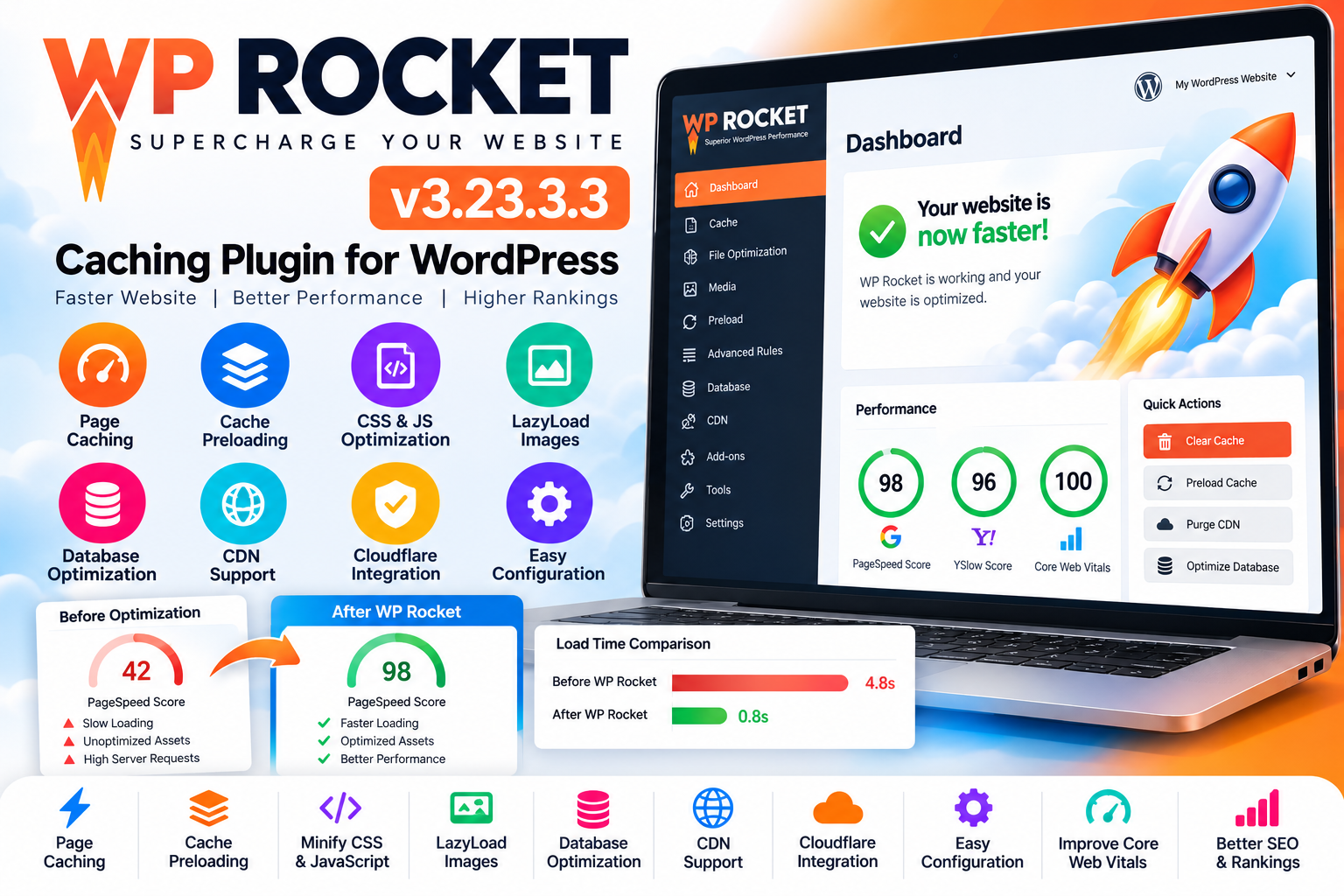
WP Rocket v3.23.3.3 is a powerful Caching Plugin for WordPress designed to improve website loading performance through caching and a range of optimization features. It provides tools for page caching, cache preloading, browser caching, CSS and JavaScript optimization, media loading optimization, database cleanup, and CDN integration.
Unlike a basic caching solution that only stores page copies, WP Rocket combines caching with additional front-end optimization tools. This makes it useful for WordPress business websites, blogs, WooCommerce stores, news websites, agency websites, portfolios, and content-heavy websites.
According to WP Rocket's official documentation, page caching can reduce PHP processing and database requests by serving cached HTML files to visitors.
WP Rocket v3.23.3.3 automatically creates cached versions of pages so returning requests can be served without running the complete WordPress PHP and database process each time.
WP Rocket explains that page caching saves page content as HTML files, reducing PHP processing and database requests for cached pages.
This can be especially useful for websites receiving regular traffic where many visitors request the same pages.
Cache preloading helps generate cached files before a visitor requests a page for the first time.
WP Rocket's documentation explains that its preload process can generate cache files from sitemap URLs and other discovered URLs, and it can automatically preload relevant pages after cache-clearing events.
This helps maintain an active cache rather than waiting for individual visitors to generate it.
WP Rocket can configure browser caching so certain frequently used resources can be stored locally by visitors' browsers, potentially reducing repeated downloads.
Browser caching works alongside page caching and other optimization functions as part of the overall performance setup.
WP Rocket v3.23.3.3 includes CSS optimization tools designed to reduce the amount of stylesheet data that needs to be transferred.
Its Minify CSS feature removes unnecessary whitespace and comments from CSS files, reducing file size. WP Rocket documents this function under its File Optimization settings.
WP Rocket provides JavaScript optimization options including minification, deferred loading, and delayed JavaScript execution.
According to the official documentation, JavaScript minification reduces unnecessary characters, while deferred and delayed loading can reduce the impact of JavaScript on initial page loading.
These options can be particularly useful on websites that rely on multiple scripts and third-party services.
LazyLoad can prevent certain images, iframes, and embedded content from loading until they are needed.
WP Rocket documents LazyLoad as a way to improve media performance by loading supported resources when they approach the visitor's viewport.
This can help reduce the amount of content that needs to be loaded immediately when a page opens.
Websites with large numbers of images can benefit from controlling how media resources are loaded.
WP Rocket includes media-related optimization options that can help reduce unnecessary initial loading, while its documentation also provides options for prioritizing important images.
For best results, image compression and correct image dimensions should still be handled as part of the overall WordPress optimization process.
WP Rocket v3.23.3.3 includes database optimization tools for cleaning selected types of WordPress database data.
The official documentation lists cleanup options for items such as post revisions and other database elements, and recommends creating a database backup before running cleanup operations because these changes may not be reversible.
A content delivery network can help deliver static resources from locations closer to website visitors.
WP Rocket supports CDN integration and also provides RocketCDN options within its broader performance ecosystem.
This can be useful for websites serving visitors from different geographic regions.
WP Rocket includes add-ons and integration options for services such as Cloudflare and Sucuri, helping users manage cache-related functionality alongside these services.
Modern WordPress websites frequently use external scripts for analytics, advertising, social media, fonts, widgets, and other services.
WP Rocket provides several tools intended to reduce the impact of third-party resources, including deferred JavaScript, delayed JavaScript execution, LazyLoad, font preloading, and external-domain optimization options.
WP Rocket v3.23.3.3 can be used on a wide variety of WordPress websites, including:
Business websites
Blogs
News websites
Magazine websites
WooCommerce stores
Agency websites
Portfolio websites
Membership websites
Service websites
Content publishers
Affiliate websites
Different websites may require different optimization settings, so features should be enabled and tested according to the site's hosting environment, theme, plugins, and functionality.
WooCommerce stores often contain product images, JavaScript, CSS, dynamic content, cart functionality, checkout pages, and third-party integrations.
WP Rocket v3.23.3.3 can be incorporated into a WooCommerce performance strategy by caching appropriate pages and optimizing static resources.
Dynamic and user-specific WooCommerce areas should be configured carefully so shopping-cart, checkout, account, and other personalized functionality continues to work correctly.
Elementor websites can contain substantial CSS, JavaScript, images, fonts, widgets, and third-party resources.
WP Rocket can complement an Elementor-based website by providing caching and front-end optimization features such as CSS and JavaScript optimization, LazyLoad, browser caching, and cache preloading.
When optimization settings are changed, it is important to test Elementor pages, popups, forms, animations, menus, and interactive elements.
News and magazine websites commonly contain many images, advertisements, embedded media, tracking scripts, and frequently updated articles.
WP Rocket v3.23.3.3 can help manage caching and optimization for these content-heavy websites, while cache preloading can help keep updated pages available in the cache.
Publishers should also ensure that frequently updated content is correctly purged and regenerated when changes are made.
WP Rocket combines several optimization techniques rather than relying on caching alone.
Depending on configuration, the plugin can help with:
Page caching
Cache preloading
Browser caching
CSS minification
JavaScript minification
Deferred JavaScript
Delayed JavaScript execution
LazyLoad
Database optimization
Font optimization
CDN integration
Third-party resource optimization
These features can work together to reduce the amount of processing and data required during page loading.
Website performance is influenced by many factors, including hosting, page structure, images, CSS, JavaScript, fonts, and third-party scripts.
WP Rocket documents several features that may help improve loading-related metrics, including page caching, delayed JavaScript, Remove Unused CSS, CSS optimization, and image prioritization.
However, no caching plugin can guarantee a particular PageSpeed score or Core Web Vitals result. Actual performance depends on the complete website environment.
One of the advantages of WP Rocket v3.23.3.3 is that many performance optimizations are available from the WordPress dashboard.
WP Rocket states that its automatic options apply a set of commonly used web-performance practices after activation, while advanced settings allow additional optimization and customization.
This makes it suitable for users who want a centralized performance toolkit rather than managing every optimization manually.
WP Rocket provides controls for clearing and rebuilding cached content.
When website pages are updated, relevant cache files can be cleared and regenerated so visitors receive current versions of the content. Its preload system can then regenerate cache files after cache-clearing events.
This is useful for websites that are updated frequently.
The official WP Rocket changelog lists WP Rocket v3.23.3.3 as released on August 27, 2026. This version included a security fix related to potentially publicly reachable configuration-file backups in certain server configurations and a bug fix addressing a fatal error when clearing cache under a specific deleted_post hook condition.
For a DownloadDevil product listing, the package should be clearly identified as v3.23.3.3 rather than being described as the latest version.
Improve caching and performance management from the WordPress dashboard.
Optimize content-heavy websites with caching and media-loading controls.
Use caching and front-end optimization as part of an eCommerce performance strategy.
Configure advanced optimization settings for different WordPress environments.
Use a centralized performance plugin across supported client websites.
Manage caching and optimization for business, eCommerce, publishing, and service websites.
Using WP Rocket v3.23.3.3 provides a broad collection of WordPress performance tools in one plugin.
Page caching
Cache preloading
Browser caching
CSS minification
JavaScript optimization
Deferred JavaScript
Delayed JavaScript execution
LazyLoad
Database optimization
Font optimization
CDN integration
Cloudflare integration
Sucuri integration
Third-party script optimization
Performance-focused configuration
Centralized cache management
Website speed is one part of a broader SEO strategy. A well-configured caching plugin can support a technically healthier website, but search performance also depends on content quality, site architecture, backlinks, mobile usability, indexing, structured data, and other factors.
For an SEO-focused WordPress setup, combine WP Rocket v3.23.3.3 with:
Optimized images
Good-quality hosting
Clean website architecture
Mobile-friendly design
An SEO plugin
Internal linking
Proper metadata
Useful original content
Correct structured data
Regular performance testing
WP Rocket v3.23.3.3 – Caching Plugin for WordPress is a comprehensive performance optimization solution for WordPress websites. Its combination of page caching, cache preloading, browser caching, CSS and JavaScript optimization, LazyLoad, database tools, CDN support, and third-party script optimization provides a flexible toolkit for improving website performance.
Whether you operate a business website, blog, WooCommerce store, news portal, magazine, agency website, or content platform, WP Rocket v3.23.3.3 can be incorporated into your WordPress performance workflow.
No approved reviews yet.
Login to write a review.